The 14th-Century Algorithm
Updated: May 22
The Muqaddimah, written by Ibn Khaldun in 1377, is a groundbreaking intellectual work that serves as a theoretical preface to world history, laying the early foundations for modern sociology, historiography, and economics. This book is a must read for political scientists, economists, and humanities enthusiasts because it offers profound, underlying insights into power dynamics, economics, and the lifecycle of civilizations.

The core concept of the book is Asabiyyah, defining it as the psycho-social driver, representing a deep sense of tribal solidarity or social cohesion. Rooted in shared survival and blood ties, most prominently in Bedouin cultures, this bond functions as the primary source of power. It forges unity, enabling groups to gain military dominance and establish ruling dynasties.
Ibn Khaldun argues that history follows a recurring five-stage cycle spanning about three generations, or roughly 120 years, rather than progressing in a straight line.
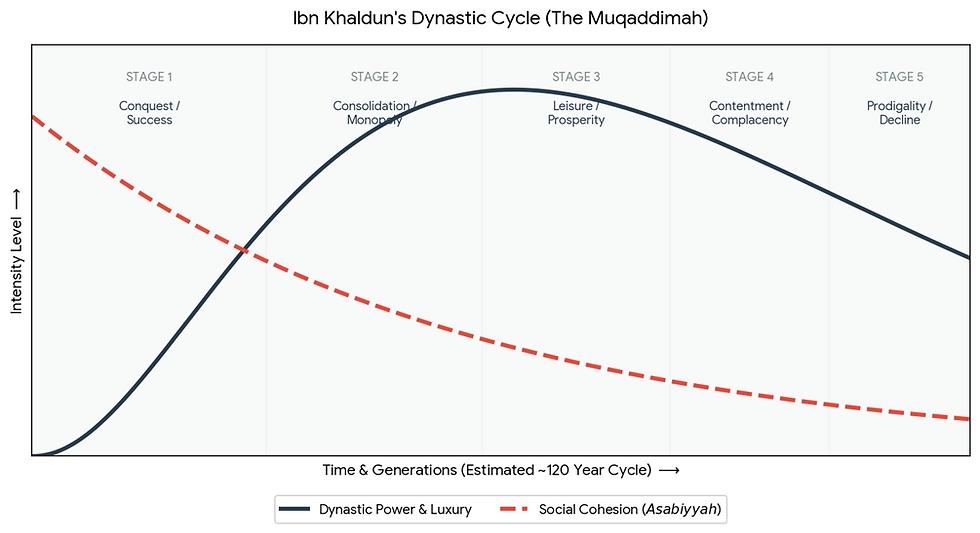
Summary of the key themes in Ibn Khaldun's Muqaddimah:
Environmental Determinism
Climate and geography directly mold human character, physiology, and social systems, with temperate zones fostering more stable, cooperative societies compared to extreme climates.
Nomadic vs. Sedentary Life
History is driven by the tension between the desert (Bedouin) and urban (Sedentary) life. While nomads possess high Asabiyyah (social cohesion) and courage, urban life offers progress but breeds luxury, moral decay, and eventual decline.
Pioneering Economics
Ibn Khaldun argued that labor, not just gold/silver, is the source of value. He developed early concepts of supply and demand, the division of labor, and noting that low taxes encourage production while high taxes ruin the economy.
Scientific Historiography
He revolutionized history by applying sociology to study the past. Rather than just recording events, he analyzed the social, geographic, and economic factors to verify the plausibility of historical reports, eliminating bias and exaggeration.



Comments