Women's Economic Inclusion is Mandatory to End Poverty
Updated: May 16
The current situation in Afghanistan, where women have been deprived of their fundamental rights to work, learn, and play an active role in society - has already produced detrimental consequences for the country, and will continue to do so for future generations.
The economic case is overwhelming:
5.1%FEMALE LABOR FORCE PARTICIPATION - 2025
| ~20%FEMALE LABOR FORCE PARTICIPATION - 2020 | $1.4BESTIMATED ANNUAL GDP COST OF BARRING WOMEN FROM WORK AND EDUCATION[1] |
Women play a crucial role in the agricultural sector in Afghanistan.
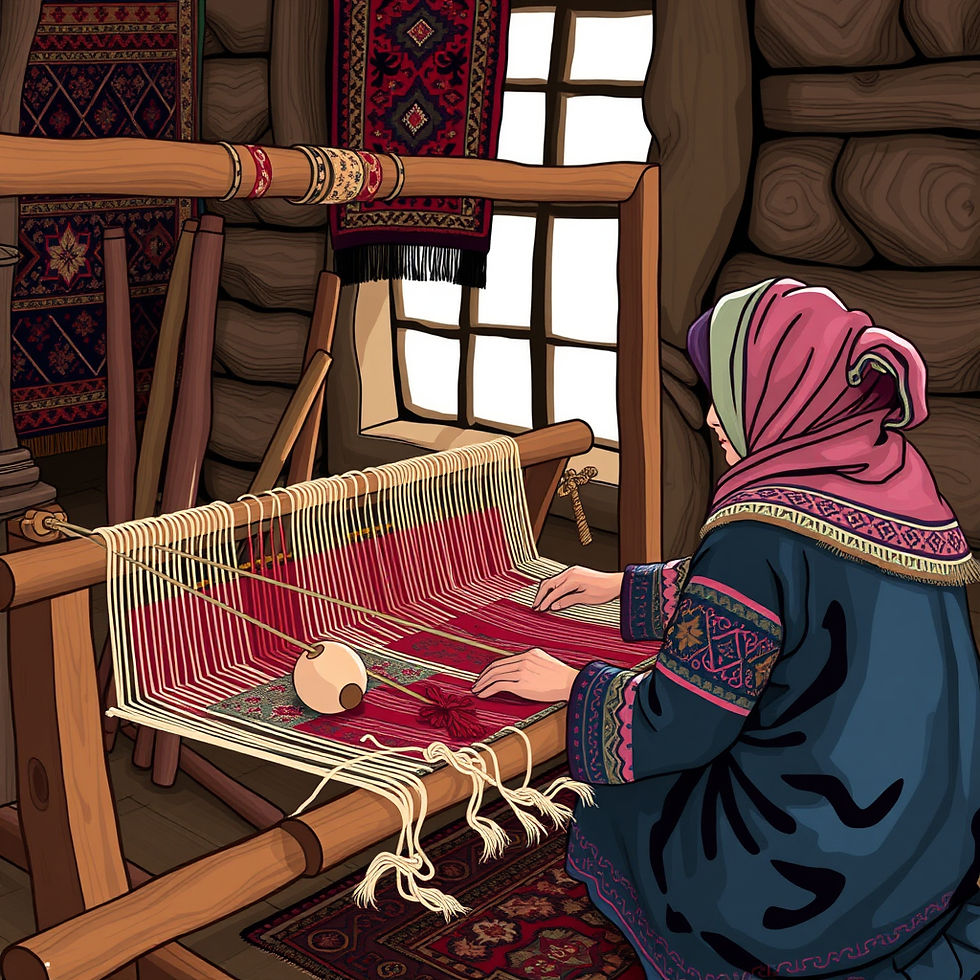
Agriculture 2 / 3 Of all laborers employed in agriculture are women, mostly at lower stages of the value chain. | Saffron 95% Of workforce in Afghanistan's saffron industry are women, according to the Afghanistan Saffron Union. | Carpets ~ 85% Of Afghanistan's carpet sector labor force is women, from gathering dye plants to spinning yarn to weaving. |
Economic adaptive facilitators in fragile zones are community networks, norms, local innovation and institutional memory. Within these adaptive systems, women's active participation serves as a cornerstone for resilient sectors during economic shocks and stressors.[2] Women’s economic participation and gender equality in the workforce generate broad benefits for household welfare, community resilience, economic recovery, and sustained economic growth. However, entrenched gender norms, social stigma, and discriminatory policies continue to constrain women’s mobility, rights, and access to safe, dignified, and paid livelihoods.
The Three Barriers to Women’s Economic Empowerment
Three structural barriers and they reinforce one another. None can be addressed in isolation.
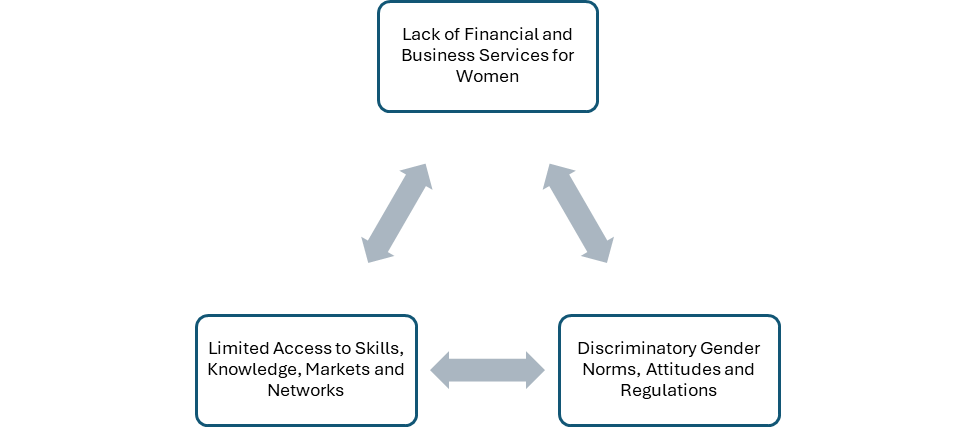
Discriminatory Norms, Attitudes & Regulations
| Limited Access to Skills, Knowledge, Markets & Networks | Lack of Financial & Business Services for Women |
Cultural prejudices, social stigma, and limitations since August 2021 has severely curtailed education, employment, and freedom of movement for women. | Women have fewer mentors, fewer professional networks, and limited entry into local, regional, and international value chains.
| Few financial products are designed for women, gender norms grant family members authority over assets, and financial literacy remains low. |
Empowering Women Through Entrepreneurship
Reducing gender disparities in the workforce and advancing women’s empowerment depends significantly on expanding women’s entrepreneurship. Women’s entrepreneurship offers a practical pathway to increase women’s economic participation in Afghanistan. Women-owned businesses often generate income and employment opportunities for other women, particularly through culturally appropriate, home-based and community-embedded business models. Policies and interventions supporting entrepreneurship stimulate labor demand especially through business ownership and value-chain participation leading to timely economic gains without requiring rapid shifts in deeply embedded social norms or operating outside existing restrictions.[4] Women-owned businesses create multiplier effects by generating jobs and income for women and men as businesses expand from microenterprises to small and medium-sized enterprises (SMEs). Sustainable recovery requires engaging the full population, that means women’s economic participation is a critical pillar of household livelihoods and economic resilience.
“In the current context, operating home-based, primarily traditional businesses may initially appear as a solution for women. However, without opportunities to expand or access additional financing or markets, these businesses will gradually decline. Additionally, women entrepreneurs may face challenges in sustaining and growing beyond home-owned businesses without the chance to learn, network, and get exposed to new business ideas related to current and future market trends.”[5]
In Afghanistan, women face multiple and intersecting barriers to starting and growing businesses, underscoring the need for targeted, context-responsive interventions that support women-owned businesses.
· Address credit constraints: Women entrepreneurs face persistent financial barriers that limit business start-up and expansion. These include the lack of financial products tailored to women’s needs, restrictive gender norms that concentrate asset ownership and financial decision-making within male family members, and limited financial literacy. Addressing these constraints requires the development of non-traditional and gender-responsive financing mechanisms and/or loan products that enable women to access capital safely and sustainably.
· Digital inclusion: Rapid technological advancement particularly in financial technology (fintech) risks further excluding women entrepreneurs if they are not supported to build relevant digital skills. Persistent gender gaps in digital access and literacy limit women’s ability to participate in modern markets, manage enterprises efficiently, and achieve economic independence. Closing the digital divide through gender-sensitive targeted digital inclusion and upskilling initiatives is essential to expanding women’s economic opportunities.
· Expand access to markets, networks, and value chains: Increasing women entrepreneurs’ access to markets, business networks, and value chains is critical to enterprise growth and sustainability. Evidence shows that peer-to-peer support, mentoring, and coaching improve firm survival rates and strengthen business networks. Trusted networks provide women entrepreneurs with essential non-financial support, market information, and practical business guidance. Integrating women-owned businesses into local, regional, and international value chains expands market access, creates new business opportunities, and facilitates knowledge and technology spillovers.
· Engaging men at the household and community levels: Engaging men is a critical strategy for overcoming context-specific gender barriers that limit women’s economic participation. Support from husbands and male family members can improve women’s access to capital, information, and networks that might otherwise remain inaccessible. Securing male buy-in at the household and community levels helps create an enabling environment in which men can act as allies and champions of women’s entrepreneurship, reinforcing positive economic outcomes for families and communities.[6]
· Gender-sensitive business and entrepreneurship training: Women in Afghanistan face widespread constraints that discourage business formation and growth. While training is necessary, evidence indicates it is most effective when combined with complementary interventions such as access to finance and markets and ongoing advisory support. Training approaches that integrate technical and practical skills into existing or emerging businesses, rather than relying solely on classroom-based instruction, have demonstrated stronger and more sustainable results.
Afghanistan also is among the most challenging places in the world to do business due to political uncertainty and reliance on foreign donors for financial and human capital support. In a fragile and conflicted affected country, aspiring entrepreneurs encounter several obstacles, but those obstacles are especially severe for women, who frequently lack the necessary training, capital, and social support to establish and sustain a business.
Therefore, limitations on women’s education, career advancement and employment demand unconventional solutions from the international community and private sector.
Core Priorities | Economic Inclusion | Contextual Alignment |
|
|
|
No economy that is struggling to recover can afford to ignore the economic potential of half the population. Afghan women are essential to strengthening economic stability and recovery in this challenging context. They need not only technical and financial support, but also access to knowledge-sharing, experienced business networks, and strong role models.
[1] World Bank and ILO
[2] Alejandra Kubitschek Bujones, Katrin Jaskiewicz, Lauren Linakis, and Michael McGirr, ‘A Framework for Resilience in Fragile and Conflict-Affected Situations’, Columbia University SIPA, 2013.
[3] Constraints and Good Practice in Women’s Entrepreneurship in MENA. Case Study: New Evidence on Gender Attitudes Towards Women in Business / ILO, Impact Report Series, Issue 10. Geneva: 2018.
[4] Pinelopi Goldberg and Gaurav Chiplunkar, Aggregate Implications of Barriers to Female Entrepreneurship, NBER, July 2024
[5] Lida Nadery Hedayat and Manizha Wafeq, ‘The Economic Impact of “Gender Apartheid” in Afghanistan,’ Counterpart International, Sept 2024
[6] Mary Robbins and Amelie Duval, ‘Engaging Men in Women’s Economic Empowerment and Entrepreneurship Development Interventions,’ ILO-WED Issue Brief, 2015


Comments